

Consider the Following:
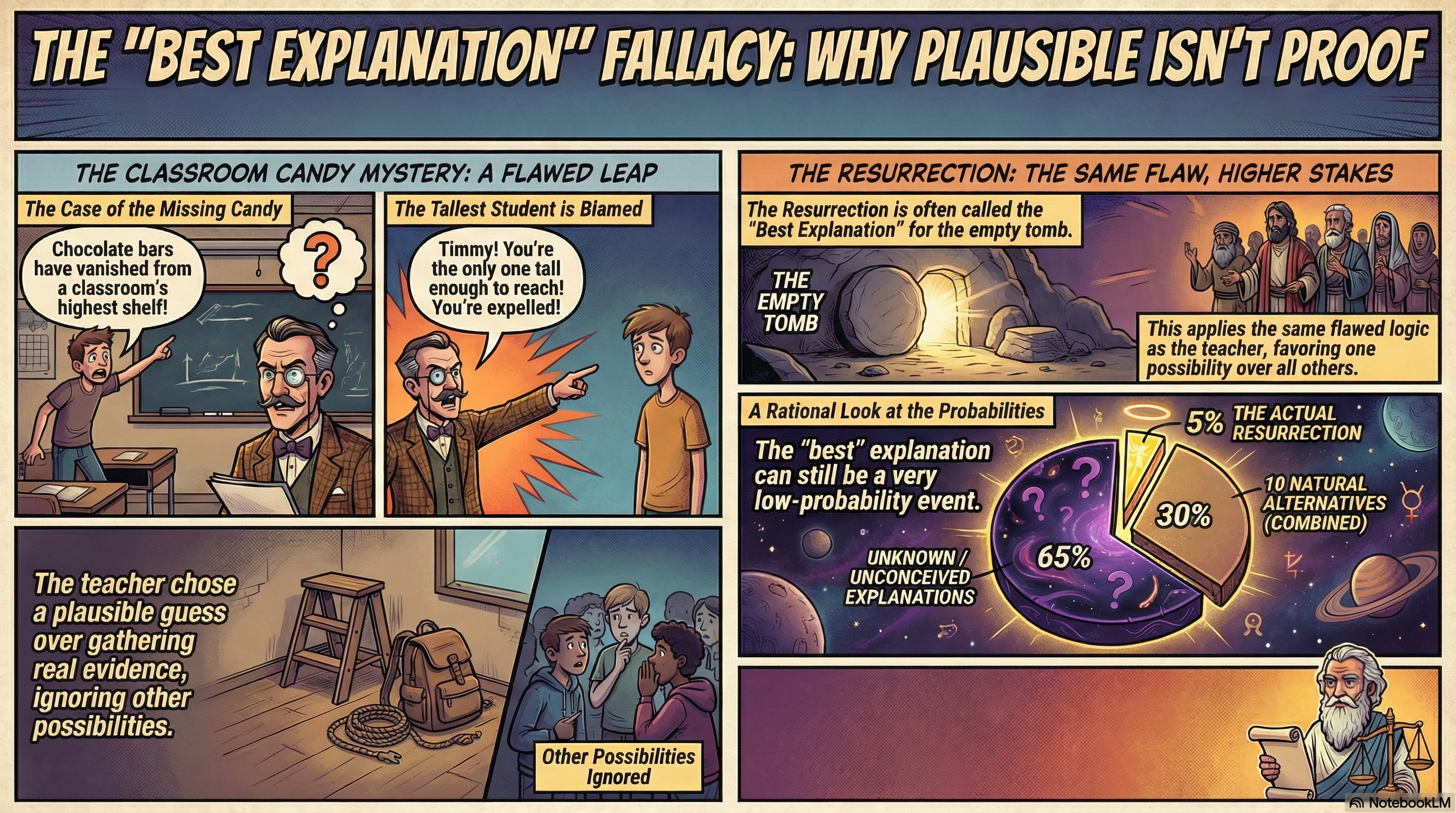
Summary: Relying on inference to the best explanation (abductive reasoning) as a basis for belief in a personal God, particularly through events like the resurrection, is insufficient due to the method’s limitations in assessing complex metaphysical claims. Without substantial evidence, using abductive reasoning for religious certainty leads to unwarranted confidence, undermining rational inquiry and neglecting alternative explanations.

Imagine a teacher named George, who finds that chocolate bars stored high on a shelf in his classroom have mysteriously disappeared. Lining up his students from tallest to shortest, he concludes that Timmy, the tallest, is the most likely culprit, assuming that Timmy’s height alone made him capable of reaching the candy. Consequently, George expels Timmy. This hasty judgment highlights a flaw in “inference to the best explanation” or “abductive reasoning“: while it can point us toward a plausible answer, it may not reveal the actual answer—especially in complex situations with high stakes. By choosing the “best” explanation based on limited data, George overlooked other potential explanations, effectively sacrificing accuracy for expedience.
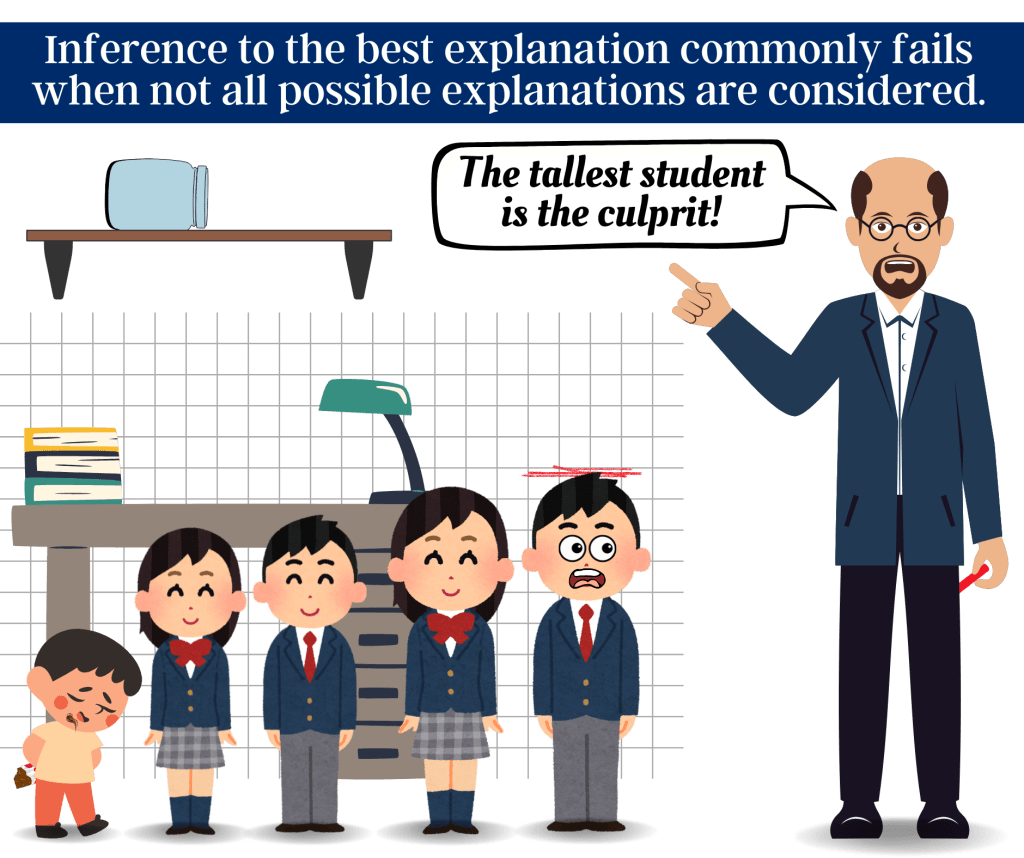
This example encapsulates a critical issue in abductive reasoning (the formal term for inferring the best explanation). While abductive reasoning is useful in areas where decisions need to be made rapidly and evidence is limited, it is unreliable when evaluating deeply consequential questions, such as beliefs in a personal God. These decisions are not binary; they involve multiple competing explanations that cannot be distilled into a simplistic choice of “most likely.” Moreover, when applied to religious claims, abduction often inflates the confidence in one explanation over equally plausible alternatives, misrepresenting probability as certainty.
Inference to the Best Explanation Blunders
1. Phlogiston Theory in Chemistry
- Summary: In the 17th and 18th centuries, scientists believed combustion released a substance called “phlogiston.” This theory was widely accepted as it explained combustion and oxidation reasonably well until Antoine Lavoisier’s oxygen theory replaced it, showing that oxygen, not phlogiston, was the active agent in combustion.
2. The Geocentric Model of the Universe
- Summary: For centuries, Ptolemy’s geocentric model, which placed Earth at the center of the universe, was considered the best explanation for celestial movement. The heliocentric model proposed by Copernicus and later confirmed by Galileo and Kepler overturned this view, establishing that Earth orbits the sun.
3. Spontaneous Generation
- Summary: For much of history, people believed that living organisms spontaneously arose from non-living matter (e.g., maggots from rotting meat). This “best explanation” was refuted by experiments conducted by Louis Pasteur in the 19th century, which demonstrated that life does not spontaneously generate but arises from existing life forms.
4. The Martian Canals
- Summary: In the late 19th and early 20th centuries, astronomers, including Percival Lowell, observed what they believed were canals on Mars, interpreting them as signs of intelligent life. This assumption was later disproven when more advanced imaging showed that the “canals” were optical illusions caused by telescope limitations.
5. Miasma Theory of Disease
- Summary: Before germ theory, people believed diseases like cholera and the plague spread through “miasma,” or bad air. This explanation was widely accepted until John Snow’s study of cholera in London and Louis Pasteur’s germ theory demonstrated that pathogens, not air quality, caused these diseases.
6. Continental Drift and Fixed Continents
- Summary: When Alfred Wegener proposed continental drift in 1912, the best explanation for Earth’s geological features remained fixed continents, despite mounting geological evidence. Wegener’s theory was initially dismissed until the development of plate tectonics in the 1960s provided a comprehensive explanation for continental movement.
7. Ether as the Medium of Light
- Summary: Scientists once assumed that light traveled through a substance called “luminiferous ether,” as sound requires a medium like air. The Michelson-Morley experiment in 1887 contradicted this theory, leading to the development of Einstein’s theory of relativity, which showed that light can travel in a vacuum without a medium.
8. Ulcers Caused by Stress and Diet
- Summary: Until the 1980s, stress and spicy foods were considered the main causes of stomach ulcers. However, Australian doctors Barry Marshall and Robin Warren discovered that most ulcers are caused by the bacterium Helicobacter pylori, revolutionizing ulcer treatment.
9. “Missing Link” Piltdown Man Hoax
- Summary: In 1912, British archaeologists believed they had found the “missing link” between apes and humans with the Piltdown Man fossils. This “best explanation” for human evolution was later debunked in 1953, revealing the fossils were a hoax created by combining human and orangutan bones.
10. The Static Universe
- Summary: For a long time, astronomers believed the universe was static and unchanging. Einstein even introduced the cosmological constant to support this model, but Edwin Hubble’s discovery of an expanding universe in 1929 led to the Big Bang model, invalidating the static view.
The Issue with Elevating Probability to Certainty
Religious leaders frequently present Christianity as “the best explanation” for the universe’s mysteries, suggesting that it offers a comprehensive answer for questions like the origin of life, human morality, and the meaning of existence. However, even if Christianity seems like the best explanation within a particular framework, its probabilistic advantage does not equate to certainty. Consider this scenario: if Christianity holds a 36% probability of being true, with other explanations (like secular humanism or other religious frameworks) holding the remaining probabilities, then proclaiming Christianity as the ultimate truth disregards the residual uncertainty.
This leap from probabilistic reasoning to confident belief bypasses the epistemic humility required when dealing with metaphysical questions. Just as George’s assumption that “Timmy’s height makes him the best candidate” unfairly singles Timmy out based on superficial probability, religious adherence based solely on abductive reasoning risks unwarranted confidence. Relying on inference to the best explanation alone can lead individuals to overlook competing explanations with potentially similar probabilities, thus skewing their approach to rational inquiry.
The Resurrection as a Case Study in Abductive Reasoning
A central claim in Christianity is the resurrection of Jesus. This event is often defended as the “best explanation” for the rise of Christian belief. Advocates argue that alternative theories—such as body theft, mistaken tomb identity, survival post-crucifixion, or a fabricated story—lack plausibility, leaving resurrection as the most coherent explanation. Yet, in terms of probability, each theory may be equally unlikely, suggesting that the “best” explanation is only slightly better than several improbable ones.
Candidate Explanations for the Alleged Empty Tomb
1. The Swoon Theory
- Explanation: Jesus did not actually die on the cross but merely fell into a state of unconsciousness or “swooned.” After being taken down, he revived in the tomb, leading followers to believe he had risen from the dead.
2. The Stolen Body Hypothesis
- Explanation: Jesus’s body was removed from the tomb by his followers or others. This act was either to preserve his body from desecration or to present the appearance of resurrection, causing later witnesses to conclude he had risen.
3. Wrong Tomb Theory
- Explanation: The followers of Jesus went to the wrong tomb, which was empty. Mistaking this empty tomb for Jesus’s resting place, they assumed he had risen, and the belief spread from there.
4. Hallucination Hypothesis
- Explanation: Jesus’s disciples and followers experienced vivid grief-induced visions or hallucinations, mistaking these for real appearances of the resurrected Jesus. This explanation suggests that belief in the resurrection stemmed from psychological phenomena rather than actual events.
5. Legend or Myth Development
- Explanation: The resurrection narrative developed gradually as a myth, embellished over time by followers who wished to preserve Jesus’s teachings and elevate his status. This explanation suggests the resurrection story evolved through oral tradition, similar to other religious and historical myths.
6. Spiritual Resurrection Interpretation
- Explanation: Some early followers believed in a spiritual rather than a physical resurrection, interpreting experiences of Jesus’s presence as spiritual manifestations rather than bodily appearances. Over time, this spiritual belief may have been reinterpreted or misinterpreted as a physical resurrection.
7. Twin or Look-Alike Theory
- Explanation: According to this less common theory, someone resembling Jesus, such as a twin or close look-alike, was mistaken for him after his death. This led followers to believe they were witnessing Jesus’s resurrection.
8. Delayed Burial and Decomposition
- Explanation: If the burial process was delayed, decomposition might have quickly obscured Jesus’s body, or it could have been removed by animals or grave robbers. Upon discovering an empty tomb, followers could have assumed Jesus had risen, interpreting the empty grave symbolically.
9. Intentional Hoax by Followers
- Explanation: Some suggest that Jesus’s disciples fabricated the resurrection story to maintain the movement and spread his teachings, believing that a powerful myth would inspire others. This view posits that early believers justified the deception to preserve Jesus’s legacy.
10. Mass Psychogenic Illness
- Explanation: Mass psychogenic illness, a phenomenon where groups experience similar hallucinations or perceptions, may explain the post-resurrection sightings. This naturalistic view suggests that communal reinforcement of belief led groups to report similar “encounters” with the risen Jesus.
When an explanation appears slightly more plausible than others, it does not imply it is true—it merely reflects its relative position among other unlikely scenarios. Abduction’s role in religious claims like the resurrection overlooks the need for overwhelming evidence when extraordinary events are proposed. Just because the resurrection could be the “best explanation” given the available evidence does not justify elevating it to absolute certainty or using it as the bedrock for a worldview. Without substantial, corroborative evidence, this use of abductive reasoning becomes precarious, risking an epistemic leap that bypasses rational scrutiny.
Let’s look at this more deeply.
Probability Distribution of Known and Unknown Explanations
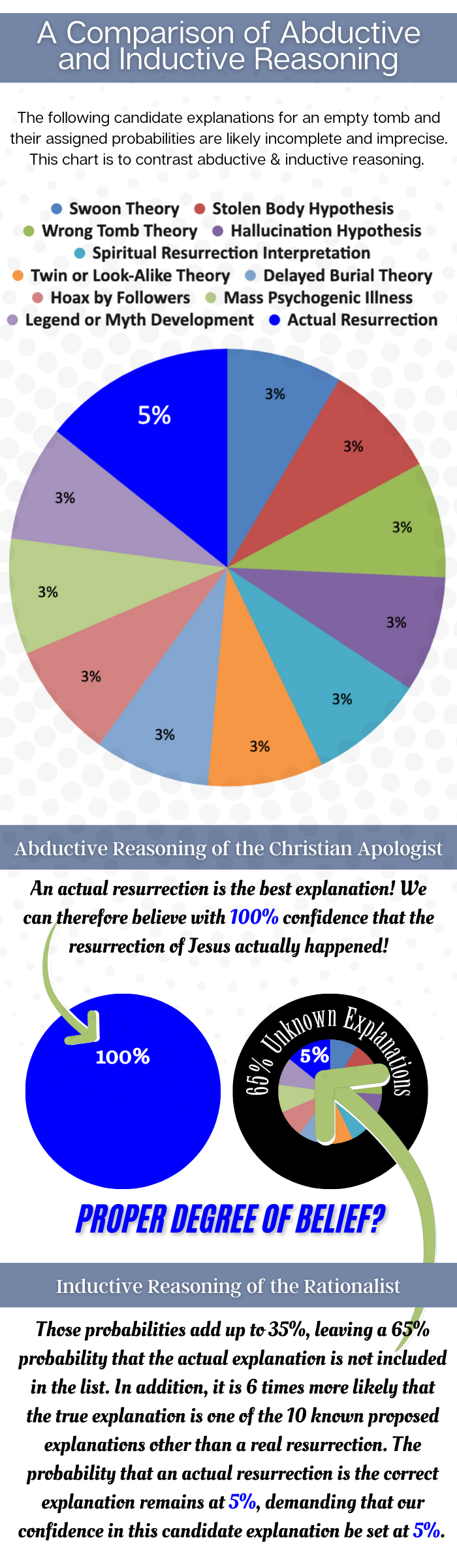
The probabilities assumed below are hypothetical and serve only to explore the intrinsic weaknesses of abductive reasoning.
- Alternative Explanations (Combined Probability: 30%)
- Each alternative explanation: 3%
- Examples include:
- Swoon Theory: 3%
- Stolen Body Hypothesis: 3%
- Wrong Tomb Theory: 3%
- Hallucination Hypothesis: 3%
- Spiritual Resurrection Interpretation: 3%
- Twin or Look-Alike Theory: 3%
- Delayed Burial Theory: 3%
- Hoax by Followers: 3%
- Mass Psychogenic Illness: 3%
- Legend or Myth Development: 3%
- Actual Resurrection (Single Explanation Probability: 5%)
- An actual resurrection occurring as claimed: 5%
- Unknown Explanations (Combined Probability: 65%)
- Any explanation not currently known or conceived: 65%
This distribution sums to 100%.
The Christian apologist will perennially abuse the notion of abductive reasoning and attempt to illegitimately equate the “best explanation” with an explanation deserving of full confidence.
Inference to the Best Explanation and the Probability Fallacy
When proponents of the resurrection use inference to the best explanation (IBE), they claim that the actual resurrection is the most plausible explanation among the known options. They argue that, since this explanation has the highest individual probability (5%), it should be the accepted explanation and with full epistemic certainty.
However, this reasoning ignores several important probabilistic and logical factors:
- Failure to Account for Cumulative Probability of Alternative Explanations: By focusing on the 5% assigned to an actual resurrection, the IBE approach overlooks the combined probability of 30% for alternative explanations. Although each alternative may appear less likely on its own, collectively they present a significant combined probability, six times that of the actual resurrection. Ignoring this cumulative probability skews the evaluation in favor of the single best explanation, without acknowledging the strength of the collective alternative explanations.
- Disregard for Unknown Explanations: With an epistemically humble probability of 65% assigned to unknown explanations, the proponents of IBE dismiss the vast range of plausible but currently inconceivable explanations. Unknown explanations, given their overwhelmingly high probability, should be integral to any fair consideration. By disregarding this 65%, IBE users fail to acknowledge the limitations of current knowledge, effectively placing undue weight on the explanations we already know.
- Overconfidence in Limited Knowledge: Relying on IBE in this scenario leads to overconfidence in known explanations, assuming that our existing set of explanations captures all possibilities. History has repeatedly shown that unknown explanations often emerge to challenge or replace established ones, especially in complex, high-stakes cases like the resurrection.
- Misinterpretation of “Significant Probability”: Claiming that an actual resurrection is “significantly more probable” than any single alternative explanation ignores that “significant” should apply to cumulative probabilities. The combination of all known alternative explanations (30%) is six times greater than the probability of an actual resurrection (5%), and unknown explanations have an even greater likelihood (65%). Thus, any conclusion that disregards this aggregate probability is logically flawed.
Implications of Ignoring Cumulative Probabilities in IBE
The decision to depend on IBE and ignore cumulative probabilities results in the following rational issues:
- Bias Toward Single Explanations: By focusing only on the single most probable explanation (resurrection at 5%) without acknowledging the 30% cumulative probability of alternatives, this approach biases conclusions toward isolated explanations rather than a fair assessment of all plausible options.
- Ignoring Epistemic Humility and Unknown Possibilities: The exclusion of unknown explanations (65%) reveals a disregard for epistemic humility, as it assumes our present knowledge can fully account for a complex phenomenon. Rational inquiry, especially concerning supernatural claims, should account for unknown possibilities, which hold a majority probability in this case.
- Misrepresentation of “Best Explanation”: IBE proponents may claim that the resurrection is the “best” explanation based on the highest individual probability. However, this argument misrepresents “best” by not acknowledging that cumulative alternative probabilities outweigh the single explanation of resurrection, making it irrational to favor the resurrection without considering the overall probability landscape.
- Underestimation of Rational Uncertainty: Rationally, one should retain uncertainty when cumulative probabilities indicate a significant chance of error. Here, with 95% of the total probability distributed among alternatives and unknowns, rational uncertainty should prevail, rather than a confident conclusion based solely on IBE.
Conclusion: Rational Approach to Probabilities Beyond IBE
A rational assessment that respects both the probability of known explanations and the humility of unknown explanations would view the actual resurrection as one possibility among many, rather than the definitive answer. By focusing on IBE and dismissing cumulative probabilities, proponents of the resurrection overlook a large array of plausible explanations, thereby reaching a conclusion that is not epistemically justified.
In sum, inference to the best explanation is insufficient for high-stakes claims such as the resurrection, where cumulative probabilities and unknown possibilities must be acknowledged to avoid intellectual overconfidence and probabilistic error.
The Redemptive Failure of the Resurrection
The assessment of the various explanation of the claims of a resurrection becomes unnecessary once we understand that an actual resurrection would reflect a failure of Jesus to pay the actual penalty for sins as defined by mainstream theology.
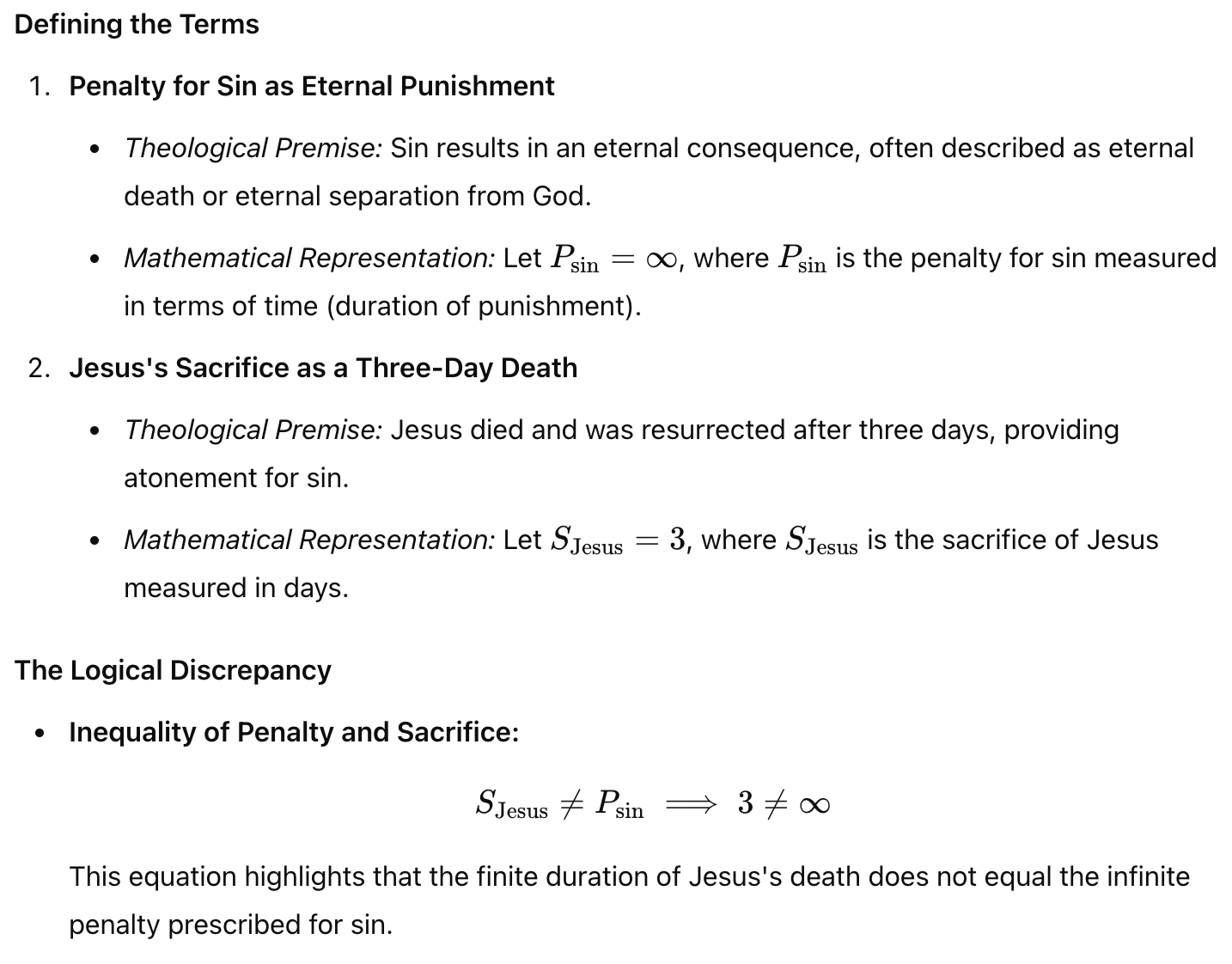
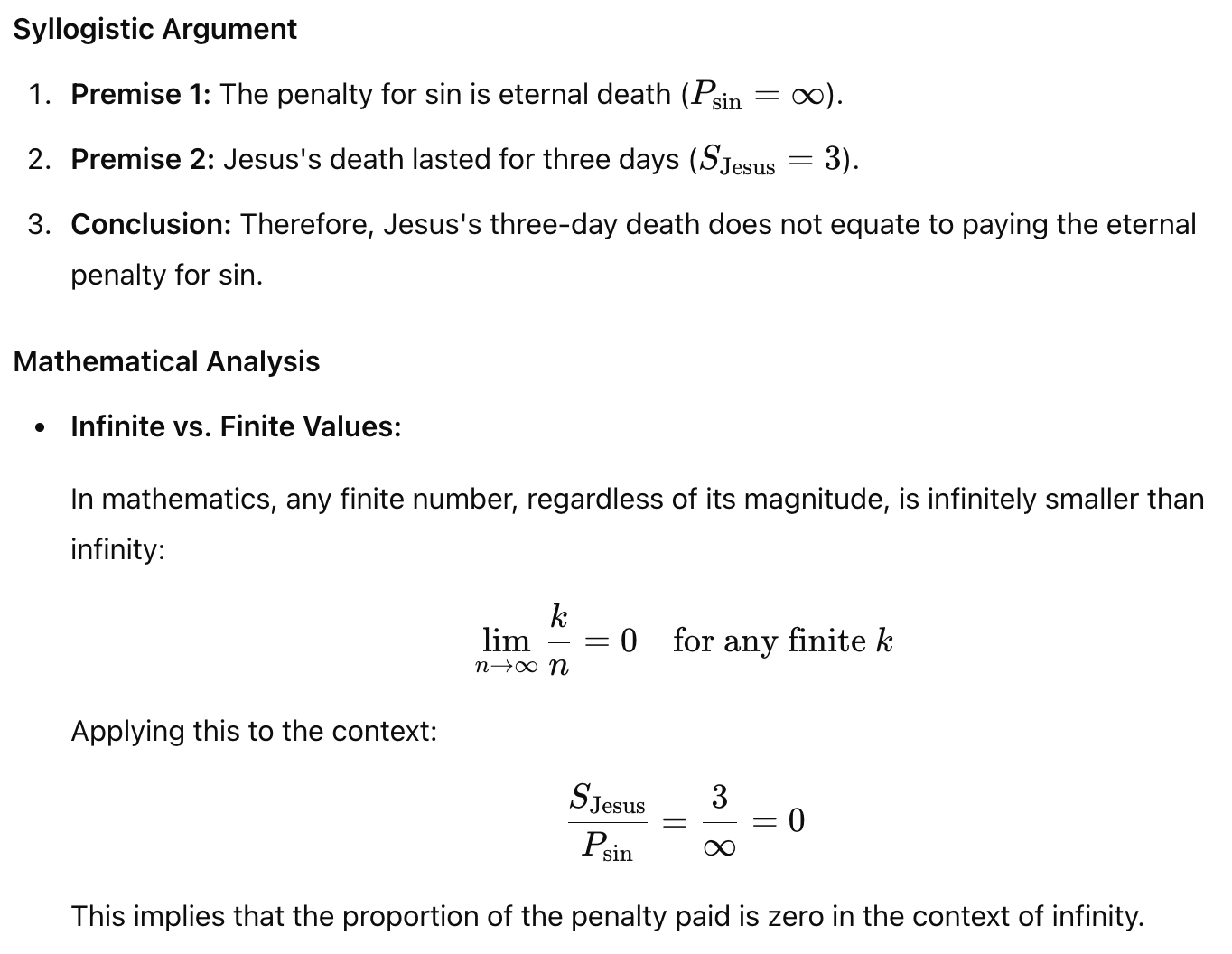
Click on the symbolic logic section for a larger view.
Unanswered Questions: The Demand for More Robust Evidence
If the resurrection is indeed the central miracle that validates Christian belief, then why does the evidence supporting it fall short of what one might expect for a claim of such importance? Why wouldn’t Jesus, if indeed resurrected, continue to live and interact with his followers to solidify this belief unambiguously? If the goal of the resurrection is to provide proof of divinity, then a single historical account seems insufficient, especially when other religions also cite miraculous events as “best explanations” for their beliefs. This raises questions about the epistemic standards applied: should extraordinary claims not demand extraordinary evidence?
The notion that a lack of overwhelming evidence preserves human free will is commonly cited, but this rationale complicates the issue further. If withholding clear evidence is intended to maintain free will, does this imply that belief is of a lesser priority than autonomy? And if so, what does this suggest about the coherence of a system in which salvation is contingent on belief, yet evidence is withheld?
The Limitations of Abductive Reasoning in Faith
Using inference to the best explanation as a foundation for religious belief is fraught with pitfalls. While it can be a helpful tool in many areas, it falls short in the realm of metaphysical and theological inquiry, where the stakes are high, and the questions are complex. The reliability of such an approach diminishes as the complexity of explanations and the improbability of each option increase. For those seeking to anchor their worldview in rational principles, abductive reasoning, without significant evidential support, provides a precarious foundation.
The Irrational Discounting of “Unknown Explanations” in Explanatory Reasoning
In discussions of extraordinary events or phenomena, we often rely on established explanations, dismissing the category of “unknown explanations” as if our current theories exhaust all possible answers. This discounting is irrational, as history shows that humanity’s explanatory repertoire has repeatedly expanded, incorporating previously unimagined or “unknown” explanations once new evidence or insights emerged. Ignoring unknown explanations not only narrows our understanding but also injects overconfidence into theories that may ultimately prove limited or erroneous.
The Importance of “Unknown Explanations”
When exploring phenomena with complex implications—whether religious, scientific, or historical—”unknown explanations” represent the potential for insights beyond our current intellectual horizon. This category acknowledges that there may be explanations yet unformulated, methods yet undiscovered, or evidence yet unseen that could fundamentally shift our understanding. By excluding unknown explanations, we unwittingly fall into a trap of epistemic closure, assuming that our current frameworks and explanations are definitive. This mindset has historically impeded progress, as demonstrated by cases like the acceptance of germ theory after miasma theory, or the discovery of quantum mechanics following classical mechanics.
Rational inquiry, therefore, should always include the category of unknown explanations, especially when evaluating extraordinary claims or ambiguous evidence. This inclusion encourages intellectual humility and guards against premature conclusions.
Calculating the Weight of Unknown Explanations: A Historical Perspective
To estimate the importance of unknown explanations, we can look at historical shifts in scientific and philosophical understanding. For example, prior to the 20th century, many phenomena—such as the nature of light, the structure of atoms, or the causes of diseases—were only partially understood, with explanations like ether theory or miasma theory widely accepted. Each of these has since been replaced by unknown explanations that, while previously unrecognized, have since become central to modern science. By examining the frequency and scale of these paradigm shifts, we can begin to assign a rough probability to unknown explanations.
One potential calculation could involve a historical replacement ratio: the proportion of theories or explanations that were dominant at a given time but were later replaced or significantly altered by unknown explanations. For instance, if 30% of dominant theories from the 19th century were eventually replaced by theories rooted in unknown factors, we might estimate a similar likelihood of current explanations being challenged by unknowns in the future.
Alternatively, a retrospective probability analysis could examine major fields—such as medicine, physics, and psychology—and measure the proportion of unknown explanations that have redefined each field over time. For instance, if advances in quantum mechanics, molecular biology, and cognitive science over the last century have each introduced transformative unknowns, we could conservatively estimate that at least 20-30% of our current dominant explanations in these fields may be similarly superseded.
Implications for Rational Inquiry

Incorporating unknown explanations into our understanding of phenomena requires us to approach explanations probabilistically, assigning weights not only to known theories but to the likelihood that unknown explanations may arise. This approach does not mean we abandon current theories; rather, it fosters intellectual humility and openness to revision. By accepting the possibility of unknown explanations, we allow our explanatory frameworks to remain flexible, preventing overconfidence and cultivating an investigative mindset.
In sum, while we may never predict unknown explanations with precision, acknowledging their potential is a rational stance that aligns with historical evidence. Just as past intellectual paradigms were reshaped by unimagined discoveries, our current understanding will likely be similarly challenged. Embracing this possibility strengthens our pursuit of truth, expanding our capacity to understand and appreciate the complexity of the world.
Relevant Technical Papers:
See also:

The Logical Form
Argument 1: Limitations of Inference to the Best Explanation for Extraordinary Claims
- Premise 1: Inference to the best explanation (IBE) is a reasoning method that selects the most plausible explanation among available options.
- Premise 2: IBE is limited in scope, as it assumes that the “best” explanation among known options is the correct one, potentially ignoring explanations not yet formulated or imagined.
- Premise 3: Extraordinary claims, such as those related to metaphysical or supernatural phenomena, often involve complex factors that may not be adequately represented by current explanations.
- Conclusion: Therefore, using IBE for extraordinary claims is insufficient because it risks prematurely favoring known explanations while discounting potential unknown explanations.

Argument 2: Historical Examples Show the Fallibility of “Best” Explanations
- Premise 1: History contains multiple examples where the “best” explanation, based on available evidence, was later shown to be incorrect (e.g., the geocentric model, phlogiston theory, miasma theory).
- Premise 2: These examples demonstrate that current understanding is often incomplete, and better explanations emerge over time as knowledge expands.
- Premise 3: Recognizing the fallibility of past explanations suggests that reliance on IBE can lead to misplaced confidence in explanations that may later be disproved.
- Conclusion: Thus, historical precedent shows that the “best” explanation is often provisional and may eventually be replaced by unknown explanations, cautioning against overreliance on IBE.
Argument 3: Incorporating Unknown Explanations Increases Epistemic Humility
- Premise 1: Rational inquiry benefits from epistemic humility, acknowledging that current knowledge may be limited or incomplete.
- Premise 2: Including unknown explanations as a possible category encourages openness to new evidence or insights that could expand or replace current theories.
- Premise 3: Ignoring unknown explanations limits the scope of inquiry, fostering overconfidence in current explanations and diminishing openness to revision.
- Conclusion: Therefore, rational inquiry should include unknown explanations to maintain epistemic humility and adapt to new discoveries.
Argument 4: Unknown Explanations are Vital for Understanding Complex Phenomena
- Premise 1: Complex phenomena, especially those involving ambiguous or supernatural claims, are difficult to explain with certainty due to multiple competing explanations.
- Premise 2: Relying solely on known explanations for such phenomena disregards the potential for unknown explanations that may provide greater accuracy.
- Premise 3: Without considering unknown explanations, conclusions about complex phenomena may be prematurely reached, leading to oversimplification and potential error.
- Conclusion: Therefore, accounting for unknown explanations is essential in understanding complex phenomena to avoid premature or incomplete conclusions.
Argument 5: The Importance of Calculating the Likelihood of Unknown Explanations
- Premise 1: Historical data reveals that many accepted explanations have been later revised or replaced by previously unknown explanations (e.g., quantum mechanics, germ theory).
- Premise 2: By analyzing historical replacement ratios or conducting retrospective probability analyses, we can estimate the likelihood that current explanations will also be supplanted.
- Premise 3: This probability estimation provides a rational basis for considering unknown explanations as part of our explanatory frameworks.
- Conclusion: Thus, the likelihood of unknown explanations can be roughly calculated, reinforcing the need to include them in our reasoning.
Argument 6: Intellectual Flexibility and the Rational Pursuit of Truth
- Premise 1: Rational inquiry requires intellectual flexibility, recognizing that explanations may evolve as new evidence becomes available.
- Premise 2: Including unknown explanations in our reasoning fosters a flexible approach that accommodates future discoveries and refinements in understanding.
- Premise 3: Excluding unknown explanations restricts this flexibility, increasing the risk of adhering to explanations that may later prove flawed.
- Conclusion: Therefore, embracing unknown explanations in rational inquiry supports a flexible, adaptive pursuit of truth that aligns with historical progress in knowledge.

(Scan to view post on mobile devices.)

Dialogues
The Role of Unknown Explanations in Understanding the Resurrection
CHRIS: Why would we even consider unknown explanations when we have solid grounds for inference to the best explanation? The resurrection makes sense as the best explanation for the empty tomb and the disciples’ conviction.
CLARUS: But relying solely on inference to the best explanation has limitations, especially for claims as extraordinary as the resurrection. History has shown that the “best” explanation often fails when new insights or unknown explanations emerge—like the shift from the geocentric model to heliocentrism or the replacement of miasma theory by germ theory.
CHRIS: I get that science evolves, but this is different. The resurrection is a unique event with a solid foundation in historical testimony, not just scientific theory.
CLARUS: Yet, even historical claims are subject to revision when new evidence comes to light. Ignoring unknown explanations simply because we can’t currently imagine them risks epistemic closure. Just as germ theory replaced miasma theory in medicine, a different framework might later explain events like the resurrection more accurately than today’s assumptions.
CHRIS: If we always hold out for unknown explanations, wouldn’t that lead to endless skepticism? Faith has to rely on some confidence, even if it’s in the best current explanation.
CLARUS: True, but rational inquiry requires a balance—epistemic humility is key. Including unknown explanations doesn’t mean rejecting confidence; it means recognizing that our explanations may be provisional. Historical data shows us that many once-“best” explanations have been replaced, suggesting that accounting for unknowns is both prudent and practical.
CHRIS: But if we always keep unknown explanations in the mix, can we ever be sure of anything? Doesn’t this undermine faith entirely?
CLARUS: Not necessarily. For highly complex claims—like miracles or metaphysical events—it’s even more critical to keep unknown explanations on the table. If we accept that the past 30% of dominant explanations were eventually replaced, we’re merely acknowledging that some unknown factor could likewise apply here. Including unknowns prevents overconfidence and respects the limitations of our current understanding.
CHRIS: So you’re saying that if we ignore unknown explanations, we risk missing out on better answers?
CLARUS: Exactly. Discounting unknown explanations could mean clinging to a “best” explanation that future evidence might challenge. Intellectual flexibility requires openness to the possibility of new discoveries. If we keep unknown explanations in view, we allow for the kind of flexible thinking that led to quantum mechanics, germ theory, and countless other advancements.
CHRIS: I understand the need for humility, but does this mean dismissing the resurrection entirely as a valid belief?
CLARUS: Not dismissing it, but approaching it with intellectual humility. Rational belief remains open to evidence, including the potential for unknown explanations. This way, our pursuit of truth is guided not just by the best explanation we currently have but by a framework adaptable to future discoveries.
CHRIS: So, rather than committing fully to one explanation, you’re saying we should hold beliefs tentatively, ready to adapt?
CLARUS: Yes, that’s the essence of rational inquiry. It’s about understanding that our current best explanations, while valuable, may not exhaust the possibilities. The rational stance is to recognize that new explanations can emerge, and being prepared for them enhances, rather than diminishes, our understanding.
Mike and Mary Discuss the Missing Chocolate Bars
In their cozy suburban living room, Mike, a frazzled fifth-grade teacher, slumps into an armchair, still in his wrinkled work shirt, venting about missing chocolate bars from his classroom’s top shelf. His wife, Mary, sits calmly on the couch with a mug of tea, ready to counter his hasty accusations with her steady logic.
MIKE: Mary, I’m absolutely livid! The chocolate bars I kept on the top shelf in my classroom are gone—vanished without a trace! And I know exactly who’s to blame: Tommy, the tallest kid in my class. He’s got the reach, no question. It’s the obvious answer, and I’m ready to march to the principal tomorrow and push for his suspension!
MARY: Hold on, Mike, let’s not rush to judgment. That sounds like you’re jumping to the most convenient conclusion, like that teacher George in the story who blamed Timmy just for being tall. He lined up the kids by height and expelled Timmy without checking other possibilities. That kind of snap decision can lead to unfair outcomes. Why don’t we explore what else might’ve happened?
MIKE: Explore what? The shelf’s way up high—Tommy’s the only one who could grab them without climbing or something. It’s straightforward: his height fits the crime. I don’t need to make this a detective case.
MARY: But that’s exactly why jumping to the “easiest” answer can be risky, especially when you’re accusing a student. Quick guesses are fine for small decisions, but for something serious like this, they can miss the mark. Like George ignoring that another kid could’ve used a chair or the bars might’ve been misplaced. This teaches us that a fast pick doesn’t always mean the right one, especially in messy situations.
MIKE: Messy? It’s just missing candy! Tommy’s height screams guilty. I’d say there’s a 40% chance it’s him, and the rest split among silly ideas like a janitor or a raccoon sneaking in. Case closed.
MARY: That’s where you’re tripping up—treating a decent guess like it’s certain. Even if Tommy seems likely, other possibilities could add up to more. Let’s break it down with some rough chances, like we read about. Say: Tommy taking them, 5%. But then: another kid using a stool, 3%; janitor moving stuff, 3%; you misplacing them, 3%; and maybe seven other ideas like that, totaling 21%. Then things we haven’t thought of: 74%. All those others together make it shaky to pin it on Tommy.
MIKE: Things we haven’t thought of? That’s just dodging the issue! In my classroom, I work with what’s in front of me. Why invent mysteries when Tommy’s the clear fit?
MARY: Because ignoring what we don’t yet know can make you too sure of yourself. Think about history—people once swore by bad air causing disease, then germs came along and flipped everything. Your Tommy theory might be like that old idea—plausible now, but maybe wrong once we dig deeper. That’s a lesson in staying open to new angles.
MIKE: But I can’t run a classroom on maybes! Kids need rules and consequences. If I don’t act on the strongest clue, they’ll think they can get away with anything.
MARY: Fair point, but good decisions come from looking wider. That quick-guess method is just a piece of a bigger approach, where you collect facts and test them. The bigger one involves checking over and over, like detectives do—gather clues, verify, tweak your thinking. It’s better for everyday stuff because it adjusts as new info pops up.
MIKE: Adjust? Tommy’s height is my clue, start to finish. Why make it complicated?
MARY: Because quick guesses can lead to mistakes, like seeing only what fits your hunch. In daily life, we need something stronger. Logically: All reasoning that thoroughly checks facts and stays flexible is better for decisions. The broader way does that, so it’s stronger. The quick way skips steps and risks errors.
MIKE: Logically, huh? Fine, but questioning everyone takes forever. What if I imagined the bars’ number? Nah, I know they were there.
MARY: That’s worth checking! Picture our knowledge like an island in a vast ocean. What we know is the land, but the ocean’s all the unknowns. Picking Tommy is like standing on the shore, thinking that’s all there is. But learning more grows the island and shows how much ocean’s left. Blaming Tommy is staying on a tiny island.
MIKE: Ocean? It’s a shelf, Mary! But maybe there’s more. Tommy’s like the trunk in that blind men and elephant story, right? The obvious bit.
MARY: Spot on! Each blind man thinks his part—trunk, leg—is the whole animal. Each has a “best” guess from their angle, but it’s partial. Your focus on height’s one piece, but unknowns might show a different story, like kids teaming up or an accident.
MIKE: Teaming up? Now you’re cooking up plots. But if I guess chances: Tommy 25%, group effort 15%, accident 10%, janitor 10%, misplaced 10%, unknowns 30%. Tommy’s still ahead!
MARY: But add them up—others total 45%, plus unknowns at 30% makes 75% against Tommy. Focusing only on the highest single guess ignores how the rest outweigh it. That’s key: Don’t miss the combined strength of other ideas.
MIKE: Combined strength? So even small chances pile up. But how do I weigh unknowns?
MARY: Look at history. About 30% of old scientific ideas got replaced by new ones we didn’t see coming. We can peg unknowns at 20-30% based on that. It keeps us grounded, knowing our ideas might shift.
MIKE: Grounded? I’m the teacher; I need to seem in charge! Admitting unknowns makes it look like I’m clueless.
MARY: Actually, showing you’re open to new facts teaches kids how to think fairly. Logically: Good thinking comes from admitting limits. Including unknowns keeps you open. Ignoring them makes you too sure and shuts down new ideas.
MIKE: New ideas, like redrawing a map. That analogy—knowledge as a map, the world as the territory. Tommy’s my old map; unknowns mean I might need a new one.
MARY: Exactly! Maps get updated with new discoveries. Your quick conclusion is a rough sketch; unknowns let you redraw it. This keeps your thinking bendy, ready for surprises.
MIKE: Surprises like maybe the bars fell behind the shelf? Wild, but possible.
MARY: That’s why skipping a full chance breakdown misleads. Calling Tommy “obvious” without weighing everything, including unknowns, pretends you’re surer than you are. Chances force you to be honest about doubts.
MIKE: Okay, let’s list more. Tommy: 15%. Falling off: 5%. Kid with help: 10%. Teacher borrowing: 5%. Misplacement: 10%. Prank: 5%. Other ideas: 20%. Unknowns: 30%. That’s 70% not Tommy!
MARY: Now you see it—the others overpower your first guess. This shows why quick answers falter for complex stuff; too many competing ideas add up. Better to propose ideas, then test with questions, observations.
MIKE: Like asking the kids what they saw? That’s doable. But if it’s Tommy, my gut was right.
MARY: And if not, you’ve dodged George’s mistake. That’s the win—avoiding unfair calls. It teaches fairness and careful thinking.
MIKE: Careful… yeah. Quick feels good in the moment, though.
MARY: But it’s risky. The quick way’s just a starting point in a bigger process. Logically: All idea starters needing checks are part of broader reasoning. The quick one is that, so it’s included in the better way.
MIKE: Included, like it’s the junior partner.
MARY: Right. For big decisions, the broader way cuts errors. Quick guesses in daily life lead to rash calls; checking thoroughly ensures you’re right.
MIKE: Rash like kicking Timmy out. Okay, I’ll ask around tomorrow.
MARY: Smart move. And complex problems especially need unknowns to avoid oversimplifying. Logically: Tricky issues have many sides. Sticking to knowns misses better answers from unknowns. Without them, you decide too soon.
MIKE: Too soon, like blaming without proof. What if a kid owns up to something?
MARY: That’s the flexibility—ready to pivot. Bendy thinking matches how knowledge grows, from old ideas to new.
MIKE: Bendy… like mental yoga. Got it. No suspension for now.
MARY: Good call. This shows how ignoring other possibilities biases you toward one idea.
MIKE: Bias, like obsessing over height.
MARY: Yep. And underplaying doubt—with 85% possibly not Tommy, uncertainty should lead, not sureness.
MIKE: Uncertainty in class? Bold move.
MARY: But strong. It models smart inquiry: Question, weigh, adjust.
MIKE: Alright, more ideas. A prank? Wrong delivery?
MARY: Nice—growing the list. Each adds to the total, pushing caution.
MIKE: And unknowns, like a wobbly shelf.
MARY: Perfect. History says unknowns matter; estimating their weight keeps us real.
MIKE: Real… unlike my flying suspicions.
MARY: Haha. Quick guesses work for small stuff, but for fairness, go deeper.
MIKE: Lesson learned. Thanks for the breakdown.
MARY: My pleasure. Now, let’s snuggle on the couch and watch that new Netflix show!
Notes:
Helpful Analogies
Analogy 1: The Island of Knowledge
Imagine humanity’s collective knowledge as an island surrounded by an expansive, uncharted ocean of unknown explanations. As we explore and expand our island, new discoveries illuminate areas we once overlooked, revealing just how much of the ocean we’ve yet to chart.
When we settle for the best explanation within our current knowledge, it’s as if we’re standing at the edge of the island, content with what we see, and assuming no other lands exist. But history shows that as our island of knowledge grows, so too does our awareness of the unknown. By ignoring the vast ocean of possibilities, we risk overconfidence, assuming that our current theories explain everything, when they may merely represent a temporary understanding.
Analogy 2: The Blind Men and the Elephant

In the classic story of the blind men and the elephant, each man touches a different part of the animal and assumes they understand the whole. One feels the trunk and concludes the creature is like a snake, while another feels the leg and assumes it resembles a tree. Each explanation is the “best” within the limits of the men’s individual experiences, yet all are incomplete.
Our use of inference to the best explanation can be similar: it allows us to interpret events or phenomena based on what we already know, but it risks being limited to partial perspectives. The inclusion of unknown explanations reminds us that our understanding of complex claims may be as incomplete as each blind man’s view of the elephant, and that new insights may reveal an entirely different “creature” than we expected.
Analogy 3: The Map and the Territory
Consider a map representing our knowledge. No map can capture the full complexity of the territory it depicts; it provides only a simplified view. Relying on inference to the best explanation is like navigating solely by an outdated map—it might lead us in the right direction, but it can’t account for changes or uncharted regions in the territory.
Including unknown explanations is akin to leaving space on the map for future adjustments. Just as explorers recognize that maps need continual revision, rational inquiry acknowledges that our understanding of phenomena—especially extraordinary claims—may evolve. By remaining open to unknowns, we’re prepared to expand the “map” of our knowledge, respecting the vastness of the unexplored “territory” that remains.
Addressing Theological Responses
Theological Responses
1. Unknown Explanations Are Not a Substitute for Evidence
Theologians might argue that while it’s true science and philosophy have historically encountered unknown explanations, this does not automatically imply that current supernatural claims lack sufficient evidence. They may suggest that discounting the evidence for the resurrection on the grounds of possible unknowns disregards the cumulative historical and testimonial support for the event, which they see as substantial in itself.
2. Unknowns Don’t Diminish the Plausibility of Inference to the Best Explanation
Theologians could argue that invoking inference to the best explanation is still rational, even if unknown explanations theoretically exist. For them, the best explanation provides the most coherent answer based on available knowledge, and without concrete evidence of viable alternatives, leaning on this inference aligns with common sense. They might contend that withholding belief until unknown explanations are fully explored could paralyze decision-making in all areas of life.
3. Faith Necessitates Trust Beyond Intellectual Certainty
Many theologians emphasize that faith often requires stepping beyond what is strictly provable, encompassing trust in both historical witness and personal experience. They could argue that an openness to unknown explanations is wise, but that faith involves a commitment beyond waiting for all possibilities to be exhausted. They might hold that epistemic humility can coexist with confident faith, as faith is ultimately a relational commitment rather than solely an intellectual conclusion.
4. Historical Evidence for the Resurrection Outweighs Hypothetical Unknowns
A common theological response may be that the historical evidence for the resurrection is compelling enough that unknown explanations are unnecessary. They might point out the transformation of the disciples, the rapid growth of Christianity, and the documented encounters with the risen Jesus as factors that provide substantial support. They could argue that unknown explanations lack any direct historical or evidential grounding, making them speculative compared to the well-documented claims surrounding the resurrection.
5. Theological Perspective on God’s Revealed Evidence
Theologians may argue that if God exists and wishes to reveal Himself, then the resurrection is a fitting way to do so, distinct from mere unknown phenomena. They could posit that the resurrection represents an intentional divine action meant to affirm Jesus’s identity and message, and that limiting the resurrection to the same category as unknown explanations overlooks its unique theological significance. For them, this miraculous event isn’t simply unexplained but is purposefully revealed evidence of God’s involvement in human history.
6. Epistemic Humility Includes Trust in Divine Revelation
Some theologians might argue that epistemic humility can involve a readiness to trust in divine revelation as well as openness to unknowns. They could suggest that true humility recognizes human limitations in fully understanding divine actions, and that faith in the resurrection is part of a humble acknowledgment that God may reveal truths in ways beyond human reasoning. Rather than viewing belief in the resurrection as closed-minded, they may see it as a balance between faith in revelation and rational inquiry.
7. Practicality of Belief vs. Endless Waiting for New Explanations
Theologians might argue that the practical aspect of faith makes waiting for unknown explanations less feasible for meaningful commitment. They could claim that a purely rational approach of holding out for new theories might hinder transformative belief or action, which are central to faith. For them, commitment to God may require a reasonable level of certainty that is not undermined by hypothetical unknowns, allowing for a practical faith that isn’t paralyzed by speculative alternatives.
Counter-Responses
1. Unknown Explanations are Necessary to a Complete Evaluation of Evidence
While theologians may argue that evidence for the resurrection is sufficient, ignoring unknown explanations risks overestimating the evidence itself. History reveals that new insights can fundamentally shift our understanding of existing evidence. The possibility of unknown explanations is not a substitute for evidence but rather a recognition that our assessment of evidence should remain open to revision. Admitting the limitations of current knowledge does not diminish genuine evidence but rather guards against the dangers of premature conclusions.
2. Rational Inquiry Should Balance Known and Unknown Explanations
While inference to the best explanation is a practical tool, it has limits, particularly for claims that defy natural understanding. Reasonable inference in daily life differs significantly from drawing conclusions about metaphysical events with immense implications. Disregarding unknown explanations for the sake of immediate answers risks intellectual closure, especially when dealing with complex, high-stakes questions. Rational inquiry must balance current knowledge with openness to unknowns, particularly for claims involving the supernatural.
3. Faith that Ignores Unknowns Risks Intellectual Overconfidence
Theological faith may indeed step beyond the merely empirical, yet rational belief should not ignore the potential for unknown explanations. Faith should not equate to intellectual overconfidence, and a balanced faith would welcome further understanding and exploration of possibilities. Embracing unknowns does not undermine faith but rather deepens it by recognizing that human understanding is limited. Thus, epistemic humility suggests a faith that is open, rather than one that dismisses potential unknown explanations outright.
4. Unknown Explanations Provide a Rational Check on Historical Claims
While historical claims about the resurrection may seem compelling, evidence-based reasoning requires a willingness to consider natural explanations that may not be fully known or understood. Significant shifts in historical understanding often arise from unexpected insights or re-interpretations of evidence. By excluding unknown explanations, we risk placing too much confidence in interpretations that, although seemingly strong, may lack comprehensive examination. A thorough investigation into historical claims is enriched, not weakened, by openness to unknowns.
5. The Concept of Divine Revelation Doesn’t Preclude Unknowns
Assuming that the resurrection represents unique divine evidence overlooks that unknown explanations do not inherently negate the theological significance of the event. Many shifts in understanding—such as quantum mechanics or germ theory—seemed inconceivable prior to their discovery and yet greatly expanded human understanding. By including unknowns, we allow space for a broader interpretation of how divinity might interact with the world, rather than assuming our current interpretation of such events is definitive.
6. Epistemic Humility Demands Openness to Both Known and Unknown Explanations
While trust in divine revelation may represent a form of humility, epistemic humility also demands openness to alternative explanations, particularly when considering extraordinary claims. True intellectual humility recognizes the limits of current knowledge and remains receptive to evidence that could reveal new dimensions of understanding. A faith that considers unknown explanations is not weaker but is instead fortified by acknowledging the scope of potential insights that lie beyond present understanding.
7. Rationality and Practical Faith Can Coexist with Openness to Unknowns
While faith often necessitates practical commitment, such commitment does not require ignoring the possibility of unknown explanations. Rational inquiry that respects unknowns does not prevent meaningful action but ensures that belief systems remain adaptable and intellectually honest. Faith in a practical context can still allow for flexibility and growth, maintaining a commitment to truth over convenience. By remaining open to the potential for unknown explanations, we balance practical faith with rigorous reasoning.
Clarifications
◉ Abductive Reasoning as a Subset of Inductive Reasoning:
Limitations and the Superiority of Induction in Everyday Life
Introduction
Reasoning processes such as abduction and induction play a central role in how we interpret the world, form hypotheses, and navigate uncertainties. While abductive reasoning—often called inference to the best explanation—serves as a useful tool in forming initial conclusions, it remains limited in scope and rigor. Abductive reasoning is a subset of inductive reasoning, which includes a broader approach to gathering, testing, and refining explanations based on accumulated evidence. This essay examines how abductive reasoning is inherently restricted compared to the full capacity of inductive reasoning and argues that inductive reasoning is superior, especially for robust understanding and decision-making in everyday life.
Abductive Reasoning: Inference to the Best Explanation
Abductive reasoning focuses on selecting the most plausible explanation from a given set of observations, often in the absence of conclusive evidence. This approach can be useful in contexts where swift interpretation is required, such as generating hypotheses in scientific research or making initial assessments in medical diagnostics. For instance, a doctor may use abductive reasoning to infer that a patient’s symptoms suggest a particular illness, based on which diagnosis currently appears to be the “best” fit.
However, this method is limited by its reliance on available knowledge and current assumptions. Because abductive reasoning does not require thorough evidence testing, it only approximates a potential answer rather than establishing robust conclusions. In scientific research, where provisional explanations can guide initial exploration, abduction serves a purpose—but it falls short when high certainty is essential. By focusing on the “best” explanation, abduction risks prematurely committing to an idea without comprehensive verification, thus narrowing the potential for accurate conclusions.
Inductive Reasoning: The Foundation for Comprehensive Understanding
Unlike abduction, inductive reasoning involves forming generalizations based on repeated observations and evidence gathering, allowing for conclusions that are both flexible and probabilistically reliable. In the scientific method, induction is foundational: hypotheses are not only proposed but are also tested through repeated experiments and peer review. This broader approach means inductive reasoning seeks not the quickest answer but the most substantiated one, emphasizing rigor and adaptability over convenience.
Inductive reasoning is inherently dynamic, allowing for hypotheses to evolve in light of new evidence. For instance, the understanding of disease transmission progressed from miasma theory to germ theory not by abductive leaps to “the best explanation” of the time but by methodical observation and repeated testing. This adaptable, self-correcting process lies at the heart of scientific advancement and effective problem-solving in everyday life. Inductive reasoning’s emphasis on accumulated evidence and continual testing enables more reliable conclusions and avoids the potential biases that can accompany abductive reasoning.
Abduction as a Subset of Induction
While abductive reasoning can serve as an entry point in hypothesis formation, it remains a subset of inductive reasoning. Abduction’s main function is to generate plausible explanations that may guide further inquiry. Once a hypothesis is formed through abduction, induction subsumes it by requiring systematic evidence gathering and repeated validation to determine whether the explanation is genuinely the most accurate. Therefore, abduction functions as a preliminary stage, but induction provides the framework for rigorous testing and refinement.
In practical terms, this means that while abduction can suggest an initial pathway, induction is the process that ensures reliability. For example, in a murder investigation, detectives may initially use abduction to form a theory based on available evidence, such as a suspect’s proximity to the crime scene. However, full inductive reasoning will guide further investigation, requiring additional evidence—such as alibis, motives, and forensic proof—to establish a case that holds up under scrutiny. This shows that abduction is only reliable when it is followed by inductive reasoning’s more thorough verification process.
The Limited Utility of Abduction in Everyday Life
In everyday life, reliance on abductive reasoning alone can lead to premature conclusions and errors in judgment. Abductive reasoning, by narrowing down options to what appears “best” without rigorous testing, can fall victim to confirmation bias and overconfidence. For example, if someone hears a noise in their house and assumes it’s an intruder based on abduction, they may act on an incomplete understanding. Inductive reasoning, however, would suggest gathering further evidence—such as checking other rooms or considering natural causes (e.g., a draft or a pet)—to determine the true source of the noise.
Everyday reasoning requires adaptability and verification, both of which are hallmarks of induction. Abductive reasoning is too limited for most practical applications in daily life, where variables are complex and often require flexible thinking. Full inductive reasoning, by gathering a broader base of evidence before reaching conclusions, reduces errors and provides a more robust understanding of situations, allowing for informed decisions rather than reactive judgments.
Inductive Reasoning as Superior for Rational Decision-Making
The superiority of inductive reasoning over abduction becomes evident when we consider the need for accuracy, reliability, and adaptability in decision-making. Inductive reasoning’s iterative approach guards against premature commitments and allows conclusions to evolve as new evidence arises. In contrast, abductive reasoning, when used in isolation, can lead to overly narrow perspectives based on currently available knowledge, which may be incomplete or biased.
For example, in making important life decisions—such as choosing a career or investing in a business—inductive reasoning is essential. Instead of defaulting to what appears to be the “best explanation,” inductive reasoning encourages examining multiple data points, experiences, and outcomes before committing. This approach provides a more comprehensive and reliable basis for decisions, making it superior in both everyday reasoning and long-term planning.
Conclusion
While abductive reasoning has its place in hypothesis generation and preliminary explanations, it remains a limited subset of inductive reasoning. Abduction offers a quick route to plausible explanations but cannot independently achieve the rigor or reliability required for robust understanding, especially in the complex, variable contexts of everyday life. Inductive reasoning, by subsuming abduction and emphasizing evidence-based verification, stands as the superior method for rational decision-making and comprehensive understanding. By incorporating inductive reasoning into our thought processes, we open ourselves to more accurate, adaptive, and thorough interpretations of the world around us.
Syllogistic Version of the Main Argument:
Syllogism 1:
- Major Premise: All reasoning methods that involve thorough evidence testing and allow conclusions to evolve are superior for rational decision-making.

Minor Premise: Inductive reasoning involves thorough evidence testing and allows conclusions to evolve.

Conclusion: Therefore, inductive reasoning is superior for rational decision-making.

Syllogism 2:
- Major Premise: All reasoning methods that lead to premature conclusions without thorough verification are limited and not superior for rational decision-making.

Minor Premise: Abductive reasoning leads to premature conclusions without thorough verification.

Conclusion: Therefore, abductive reasoning is limited and not superior for rational decision-making.

Overall Conclusion:
- Since inductive reasoning is superior and abductive reasoning is limited and not superior, inductive reasoning is superior to abductive reasoning for rational decision-making and comprehensive understanding.
Symbolic Logic Version of the Main Argument:
Let the following symbols represent the predicates and subjects:
- Let
: x involves thorough evidence testing and allows conclusions to evolve.
- Let
: x is superior for rational decision-making.
- Let
: x leads to premature conclusions without thorough verification.
- Let
: x is limited and not superior for rational decision-making.
- Let
: Inductive reasoning.
- Let
: Abductive reasoning.
Premises and Conclusions:
- Premise: All reasoning methods that involve thorough evidence testing and allow conclusions to evolve are superior for rational decision-making.
![\forall x [ E(x) \rightarrow S(x) ]](https://s0.wp.com/latex.php?latex=+%5Cforall+x+%5B+E%28x%29+%5Crightarrow+S%28x%29+%5D+&bg=ffffff&fg=000&s=0&c=20201002)
Premise: Inductive reasoning involves thorough evidence testing and allows conclusions to evolve.

Conclusion: Therefore, inductive reasoning is superior for rational decision-making.

Premise: All reasoning methods that lead to premature conclusions without thorough verification are limited and not superior for rational decision-making.
![\forall x [ P(x) \rightarrow L(x) ]](https://s0.wp.com/latex.php?latex=+%5Cforall+x+%5B+P%28x%29+%5Crightarrow+L%28x%29+%5D+&bg=ffffff&fg=000&s=0&c=20201002)
Premise: Abductive reasoning leads to premature conclusions without thorough verification.

Conclusion: Therefore, abductive reasoning is limited and not superior for rational decision-making.

Final Inference:
- Inductive reasoning is superior (
), and abductive reasoning is limited and not superior (
).
- Therefore, inductive reasoning is superior to abductive reasoning for rational decision-making and comprehensive understanding.
Explanation:
- Syllogism 1 establishes that inductive reasoning is superior because it satisfies the condition of involving thorough evidence testing and adaptability.
- Syllogism 2 demonstrates that abductive reasoning is limited due to its tendency to lead to premature conclusions without thorough verification.
- The Symbolic Logic version formalizes these arguments using logical quantifiers and implications, providing a rigorous foundation for the conclusions drawn.
- The overall argument concludes that inductive reasoning is superior to abductive reasoning in the context of rational decision-making and comprehensive understanding.
Syllogistic Version of the Proof that Abductive Reasoning is Subsumed by Inductive Reasoning:
Syllogism 1:
- Major Premise: All reasoning methods that generate initial plausible explanations and are validated through systematic evidence gathering are subsets of inductive reasoning.

Minor Premise: Abductive reasoning generates initial plausible explanations and requires validation through systematic evidence gathering.

Conclusion: Therefore, abductive reasoning is a subset of inductive reasoning.

Syllogism 2:
- Major Premise: Any reasoning process that serves as a preliminary stage and is incorporated into a broader reasoning framework is subsumed by that broader framework.

Minor Premise: Abductive reasoning serves as a preliminary stage and is incorporated into the inductive reasoning framework.

Conclusion: Therefore, abductive reasoning is subsumed by inductive reasoning.

Overall Conclusion:
- Since abductive reasoning generates initial explanations that require systematic validation and is incorporated into the broader framework of inductive reasoning, it is subsumed by inductive reasoning.
Symbolic Logic Version of the Proof:
Let the following symbols represent the predicates and subjects:
- Let
: x generates initial plausible explanations.
- Let
: x requires validation through systematic evidence gathering.
- Let
: x is a subset of or is subsumed by y.
- Let
- Let
: x is incorporated into y.
- Let
- Let
Premises and Conclusions:
- Premise: For all reasoning methods x, if x generates initial plausible explanations and requires validation through systematic evidence gathering, then x is a subset of inductive reasoning.
![\forall x [ (G(x) \land V(x)) \rightarrow S(x, I) ]](https://s0.wp.com/latex.php?latex=+%5Cforall+x+%5B+%28G%28x%29+%5Cland+V%28x%29%29+%5Crightarrow+S%28x%2C+I%29+%5D+&bg=ffffff&fg=000&s=0&c=20201002)
Premise: Abductive reasoning generates initial plausible explanations and requires validation through systematic evidence gathering.

Intermediate Conclusion: Therefore, abductive reasoning is a subset of inductive reasoning.

Premise: For all reasoning methods x, if x serves as a preliminary stage and is incorporated into a broader reasoning framework y, then x is subsumed by y.
![\forall x \forall y [ (P(x) \land B(x, y)) \rightarrow S(x, y) ]](https://s0.wp.com/latex.php?latex=+%5Cforall+x+%5Cforall+y+%5B+%28P%28x%29+%5Cland+B%28x%2C+y%29%29+%5Crightarrow+S%28x%2C+y%29+%5D+&bg=ffffff&fg=000&s=0&c=20201002)
Premise: Abductive reasoning serves as a preliminary stage and is incorporated into inductive reasoning.

Conclusion: Therefore, abductive reasoning is subsumed by inductive reasoning.
Explanation:
- Syllogism 1 asserts that any reasoning method generating initial explanations and requiring validation is a subset of inductive reasoning. Since abductive reasoning fits this description, it is concluded to be a subset of inductive reasoning.
- Syllogism 2 emphasizes that any preliminary reasoning process incorporated into a broader framework is subsumed by it. Abductive reasoning, serving as a preliminary stage in hypothesis formation and being incorporated into inductive reasoning, is thus subsumed by inductive reasoning.
- In the Symbolic Logic version, we formalize these arguments using logical quantifiers and implications:
- Premises 1-3 show that because abductive reasoning generates explanations and requires validation, it is a subset of inductive reasoning.
- Premises 4-6 demonstrate that since abductive reasoning serves as a preliminary stage and is incorporated into inductive reasoning, it is subsumed by inductive reasoning.
- The overall argument conclusively shows that abductive reasoning is subsumed by inductive reasoning due to its role and function within the broader inductive framework.
Summary:
- Abductive reasoning is a process that generates initial plausible explanations but requires systematic validation.
- Inductive reasoning is a broader framework that involves systematic evidence gathering, testing, and validation of hypotheses.
- Therefore, abductive reasoning is subsumed by or is a subset of inductive reasoning, as it functions within the inductive framework to develop and validate explanations.
Evading Probabilistic Obligations When Claiming the “Best Explanation”
In rational inquiry, asserting that a particular explanation (X) is the “best” often implies that it is more likely to be true than alternative explanations. However, this claim becomes hollow when not backed by probability assignments that realistically compare X to known alternatives and account for unknown possibilities. By failing to assign explicit probabilities, proponents of the “best explanation” can create a deceptive sense of certainty, overlooking uncertainties that a more rigorous approach would reveal. Probability assignments offer a fairer way to weigh competing explanations and provide an intellectual humility that recognizes the limitations of current knowledge. This essay examines why assigning probabilities is essential for claiming the “best explanation” and the implications of evading this obligation.
The Value of Probability Assignments
Probability assignments function as essential checks in evaluating any explanation. They allow one to gauge each known explanation’s relative strength and to represent unknown explanations as valid possibilities. Without these assignments, the “best explanation” label may appear definitive, while in reality, it may only marginally surpass other explanations—or might even be outweighed by the collective probability of alternatives and unknowns. For example, if X holds a probability of 20%, while the combined alternatives add up to 40%, and the potential unknowns are given 40%, X is no longer convincingly “best.” Instead, it becomes one viable option within a broader landscape, demanding caution rather than confidence.
This approach aligns with epistemic humility: the recognition that our current understanding is provisional and that unknown explanations may emerge to better account for a phenomenon. By assigning a significant probability to unknowns, one respects the potential for new discoveries that history has repeatedly confirmed as plausible—e.g., the unexpected transition from miasma theory to germ theory, or from Newtonian to quantum mechanics.
The Role of Unknown Explanations
Probabilities for unknown explanations safeguard against overconfidence in current theories by leaving room for new insights that may reshape our understanding. Historically, unknown explanations have frequently emerged to replace or refine what was once considered definitive. Failing to account for this in probability assignments implies an assumption that current explanations are exhaustive, a stance which leads to premature conclusions about complex phenomena. Rational inquiry, especially in cases of extraordinary claims, must adopt a comprehensive view that includes the unknown. Otherwise, one risks clinging to interpretations that future insights could easily render obsolete.
Implications of Evading Probability Obligations
Without probabilistic grounding, the “best explanation” label gives undue weight to X by neglecting the cumulative probability of alternatives and unknowns. This omission not only skews the judgment process but also encourages intellectual overconfidence. By sidestepping probabilities, proponents of X can ignore the extent to which their certainty rests on untested assumptions and unacknowledged unknowns. Additionally, this lack of probabilistic rigor promotes dogmatism, where one explanation is upheld not because it is the most substantiated but rather because alternative explanations are systematically excluded from consideration.
The evasion of probability obligations undermines the foundation of rational inquiry, which is inherently probabilistic and comparative. By failing to rigorously evaluate known and unknown alternatives, proponents of the “best explanation” miss the opportunity for a balanced assessment, leaning instead on arbitrary confidence rather than measured understanding.
Syllogisms Supporting the Argument
Syllogisms Supporting the Argument
- Syllogism 1: Probability Assignments Are Essential for Evaluating Competing Explanations
- Premise 1: Rational inquiry requires a fair and balanced evaluation of all plausible explanations.
- Premise 2: Assigning probabilities to explanations allows for a clear comparison of their relative likelihoods.
- Premise 3: Without assigning probabilities, a single explanation may appear more certain than it actually is, as alternatives are not fully accounted for.
- Conclusion: Therefore, probability assignments are essential for fairly evaluating competing explanations, preventing a deceptive sense of certainty.
- Syllogism 2: Unknown Explanations Must Be Assigned Probabilities to Acknowledge Epistemic Limitations
- Premise 1: Rational inquiry should acknowledge the limitations of current knowledge and remain open to unknown explanations.
- Premise 2: Assigning probabilities to unknown explanations allows rational inquiry to account for new possibilities that could replace or refine current theories.
- Premise 3: Failing to assign probabilities to unknown explanations implies an unfounded confidence in the completeness of current knowledge.
- Conclusion: Therefore, assigning probabilities to unknown explanations is necessary to recognize epistemic limitations and maintain intellectual humility.
- Syllogism 3: Evading Probability Assignments Leads to Intellectual Overconfidence
- Premise 1: Intellectual overconfidence arises when an explanation is presented as definitively true without accounting for alternative explanations.
- Premise 2: Probability assignments provide a structured means to consider alternatives and prevent overconfidence.
- Premise 3: Avoiding probability assignments in asserting the “best explanation” encourages overconfidence by ignoring alternative explanations and unknowns.
- Conclusion: Therefore, evading probability assignments in claiming the “best explanation” leads to intellectual overconfidence.
- Syllogism 4: Ignoring Unknown Explanations Leads to Premature Conclusions
- Premise 1: Unknown explanations have historically replaced or refined once-accepted theories, demonstrating their significance in rational inquiry.
- Premise 2: Failing to account for unknown explanations leads to the assumption that current explanations are complete.
- Premise 3: Assuming completeness of current explanations without considering unknowns results in premature conclusions about complex phenomena.
- Conclusion: Therefore, ignoring unknown explanations leads to premature conclusions and limits the scope of rational inquiry.
- Syllogism 5: Probability Assignments Are Necessary for an Epistemically Humble Approach
- Premise 1: Epistemic humility involves acknowledging that one’s current understanding may be incomplete.
- Premise 2: Assigning probabilities to known and unknown explanations reflects epistemic humility by recognizing the potential for future discoveries.
- Premise 3: Claiming an explanation as the “best” without probability assignments disregards epistemic humility and implies overconfidence in current knowledge.
- Conclusion: Therefore, probability assignments are necessary for an epistemically humble approach to understanding complex claims.
Conclusion
Claiming X as the “best explanation” without assigning probabilities creates an illusion of certainty by evading a fair assessment of known and unknown alternatives. Probability assignments reveal the true landscape of likelihoods, preventing intellectual overconfidence and promoting epistemic humility. Ignoring these assignments, particularly for unknown explanations, risks premature conclusions and limits the potential for rational growth. Rational inquiry, therefore, demands a rigorous commitment to probability, ensuring that claims about the “best explanation” are grounded in a balanced and realistic assessment.


Leave a Reply